

What I Said, What Happened
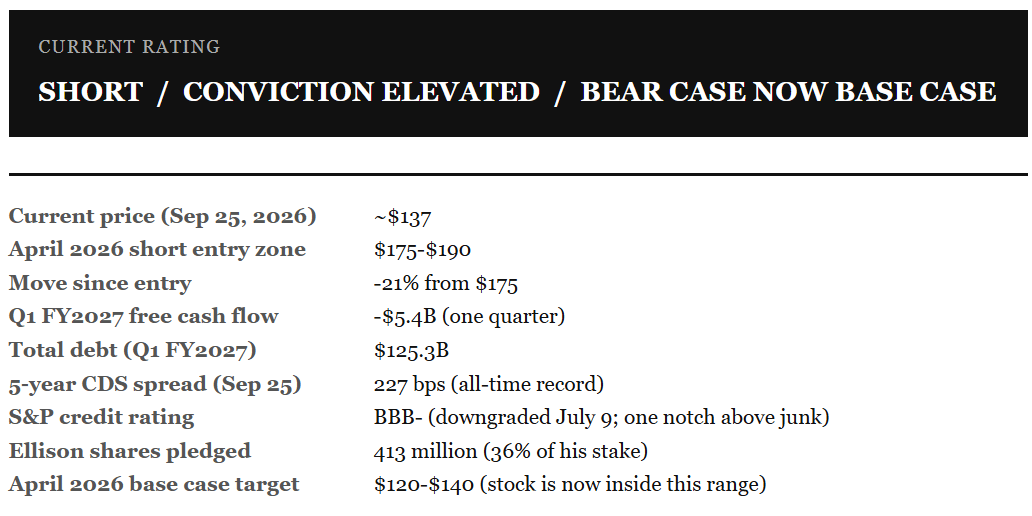
In my March 1, 2026 Discord report I recommended against entering a short at $145-150. I identified $175-190 as the correct entry zone and called for patience. In my April 26, 2026 update I confirmed the entry as the stock reached $175. The base case price target was $120-140, with the bear case at $80-100 and the stop at $200.
As of September 25, 2026, the stock is approximately $137, inside the base case target range and 21% below the April entry zone. The stop at $200 was never triggered. The thesis has tracked as published. Every major bearish catalyst flagged in April has now materialized: an S&P downgrade, a New Mexico data center force majeure notice, an all-time record in credit default swap spreads, and a new disclosure of Larry Ellison share pledges introducing a systemic feedback risk that did not exist in isolation when I first published in my Discord.
Key Developments Since April 2026
Q1 FY2027 results (September 10, 2026): Revenue $19.3B (+30%), IaaS / OCI $7.4B (+121%), capex $28.5B in a single quarter. Against quarterly operating cash flow of $23.1B, this produces a free cash flow deficit of -$5.4B in ninety days.
S&P downgraded Oracle to BBB- on July 9, 2026, one notch above junk. Oracle’s bonds now yield 8%, wider than the average B-rated high-yield index at 7.5%. The market is treating an investment-grade issuer as a junk borrower.
Project Jupiter force majeure (September 24, 2026): Oracle issued a force majeure notice on its New Mexico data center, citing a natural gas pipeline delay and pending air quality permitting. The $18B in project loans is trading at 89-91 cents on the dollar. The stock fell approximately 4.75% on the news.
5-year CDS at 227 basis points (September 25, 2026), a new all-time record, 16.2% higher week-over-week and four times the investment-grade CDS index at 53 bps.
Larry Ellison pledged 67 million additional Oracle shares as collateral (September 25, 2026), bringing the total to 413 million shares (36% of his entire Oracle stake, worth approximately $56.6B) to finance Paramount Skydance’s $111 billion pursuit of Warner Bros. Discovery.
The Credit Structure in One Paragraph
Oracle’s Q1 FY2027 capex of $28.5B in a single quarter, against quarterly operating cash flow of $23.1B, is a deficit of $5.4B generated in ninety days. This is not investment-ahead-of-revenue in the manner of a startup growing into its infrastructure. This is a mature enterprise software company converting its balance sheet into data center concrete at a rate that is outrunning its capacity to generate cash, while carrying $125.3B in existing debt and receiving a credit rating one notch above junk. The Q1 10-Q discloses $11.4B in customer prepayments that carry a “significant financing component” (cash received in advance of service delivery). Excluding those prepayments as a sensitivity gives approximately -$16.8B underlying FCF. If prepayment rates slow, reported FCF moves toward that figure without any change in infrastructure spending or operating performance.
Beyond reported debt: The Q1 FY2027 10-Q discloses $288 billion in data center lease commitments that have been signed but have not yet commenced; they sit off the balance sheet until each building enters service, generally expected between Q2 FY2027 and FY2029 under 15-to-19-year terms. There are also $34.2 billion in other long-term purchase obligations. Neither figure is debt today. Both represent contractual obligations that will become balance sheet liabilities as construction progresses.
The CDS Record and the Bond Market Verdict
Oracle’s 5-year credit default swap spread hit 227 basis points on September 25, 2026, a new all-time record for the company. The investment-grade CDS index traded at approximately 53-55 basis points on the same date. Oracle’s 6.125% notes due 2065, issued at par in February 2025, were reported trading at approximately $77.50, yielding approximately 8.0%. The average yield on bonds rated two full notches below Oracle’s formal rating was approximately 7.5% at the same point. Oracle’s investment-grade bonds are yielding more than the average junk-rated borrower.
S&P’s BBB- rating is the floor of investment grade. A single further downgrade to BB+ would trigger forced selling by investment-grade-mandated funds that currently hold Oracle debt. Moody’s remains at Baa2, one notch above S&P. If Moody’s moves to Baa3, Oracle becomes a “split-rated” crossover credit by both agencies’ lowest investment-grade rating. The capex trajectory in Q1 FY2027 provides material justification for Moody’s to take that step.
Project Jupiter: Force Majeure in New Mexico
On September 24, 2026, Oracle issued a force majeure notice to the developer of Project Jupiter, its planned 2.45-gigawatt AI data center in Dona Ana County, New Mexico. The notice cited a natural gas pipeline delay (now pushed to February 2027) and pending air quality permitting. The $18 billion in syndicated loans tied to the project were quoted at 89-91 cents on the dollar, a distressed secondary market level for a new-build construction loan.
Oracle said Project Jupiter “remains on our planned schedule.” Blue Owl Capital, which manages the project vehicle, said there was “no change to financial commitments.” Issuing a force majeure notice establishes in legal terms that circumstances beyond Oracle’s control may prevent on-schedule delivery. The loan market, not the management statement, is the more reliable signal of where institutional opinion sits. The pattern repeats: the April 2026 “on schedule” statement at Abilene preceded months of further delays.
Larry Ellison: The Pledge That Grew as the Stock Fell
Oracle’s September 2026 proxy filing disclosed that Larry Ellison has pledged 413 million shares as collateral, up 67 million (19%) from the prior year’s filing, despite the stock falling approximately 22% over the same period. At $137.10 on September 25, the pledged position is worth approximately $56.6 billion. Ellison holds approximately 40.6% of Oracle’s outstanding shares; 36% of that controlling stake is now pledged.
The pledges secure personal borrowing connected to David Ellison’s Paramount Skydance entity and its $111 billion pursuit of Warner Bros. Discovery. The proxy does not disclose loan-to-value ratios, maintenance margins, or the price thresholds at which lenders could issue margin calls. What it confirms is that the borrowing grew even as the collateral value fell: either the borrowing increased, the lenders required additional shares, or both.
The feedback loop: If the Oracle share price falls below lenders’ maintenance threshold, Ellison must provide additional collateral or liquidate Oracle shares. Forced share sales add downward pressure, reducing the collateral value of the remaining position, a self-reinforcing mechanism. The scale of the pledged position makes this a material market structure consideration at current price levels.
Risk Interconnection: How the Stresses Compound
The three events of the final week of September 2026 are individually material. Together they describe a structure where the same stresses reinforce each other:
Project Jupiter force majeure reduces investor confidence in Oracle’s data center delivery record, adds to CDS widening, and increases the probability of further rating action.
CDS at 227 bps and bonds yielding 8% raise the cost of new debt issuance and feed into the rating agencies’ quarterly review cycle. Any new equity programme to fill the capex gap would be highly dilutive at current prices.
Ellison’s 413 million pledged shares mean any news event driving the stock lower now carries second-order collateral risk. The pledge increased 19% even as the price fell.
Q1 capex -$5.4B FCF deficit narrows the $36.4B cash balance and increases the need for debt or equity issuance, directly exacerbating the CDS widening rationale.
S&P BBB- (one notch above junk) means a Moody’s cut to Baa3 plus a subsequent S&P move to BB+ would trigger forced selling by investment-grade-mandated funds. Secondary market disruption would feed back into equity via the CDS mechanism and the Ellison collateral valuation.
None of these five stress points requires a catastrophic event to move. A Moody’s rating action is a single-notch routine review outcome that the Q1 capex trajectory materially justifies. A natural gas pipeline delay into February 2027 is already confirmed. A further 10-15% decline in the share price, if it follows from either catalyst, brings the Ellison collateral into a range where lender behavior becomes a second-order risk at this scale.
Updated Valuation
At $137, Oracle trades at approximately 16-17x EV/EBITDA on FY27 estimates (versus a sector median of 12.7x), 17-18x non-GAAP earnings (sector median 18-20x), and negative free cash flow. Debt/EBITDA is approximately 4.5-5x against a sector median of 0.8x. In April the multiple was higher; in September it has compressed but has not yet reached a level that reflects the actual risk distribution. No peer trades at negative free cash flow at 17x earnings with $125B in debt and bonds yielding wider than junk.
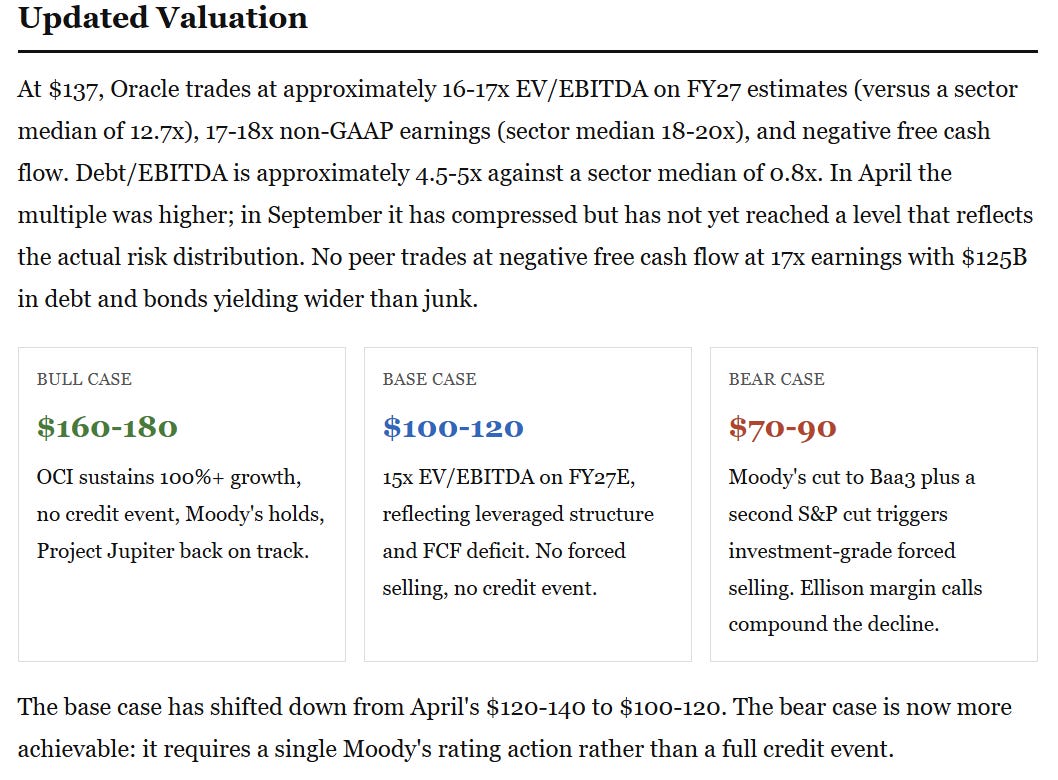
The base case has shifted down from April’s $120-140 to $100-120. The bear case is now more achievable: it requires a single Moody’s rating action rather than a full credit event.
What Would Disprove the Thesis
Three observable thresholds define the boundary between “thesis intact” and “thesis requires re-evaluation”:
FCF turns positive on a trailing-12-month basis by Q4 FY2028, excluding customer prepayments. This would demonstrate that the infrastructure program is self-financing from OCI cash generation alone.
No material new external capital in any rolling 12-month period while sustaining $80B+ annual capex. Management said the latest contracts require no capital plan increase; this threshold tests that statement over a meaningful observation window.
Key construction milestones met on revised timelines: Abilene buildings 3-8 all revenue-generating by Q3 2027; Project Jupiter natural gas pipeline by March 2027 and air quality permits by Q3 2027; no additional force majeure notices on any active campus.
If all three thresholds are met by Q4 FY2028, the short thesis rests on valuation rather than structural risk and would require reassessment.
Market Positioning (Past 30 Trading Days)
Data from the Rhodie House Options Intelligence proprietary option flow records covering approximately August 14 through September 25, 2026. The section below shows only pure directional classified options packages. This section is subordinate to the fundamental case above.
Selected Options Activity
Bearish directional packages (selected): Material put buying was distributed across the period without an obvious single catalyst. The largest print was August 21: 3,000 Mar 2027 $145 puts at $7.6M, with size representing 83% of prior session open interest (possible new positioning). September 24 saw three separate bearish structures: Jun 2027 $110 puts (2,000x $2.3M), Jan 2027 $120 puts (2,000x $1.6M), and a bearish risk reversal in Mar 2027 ($130P/$190C, 800x). Target strikes span $110-$160 across December 2026 through January 2028 expirations.
Bullish directional packages (selected): Substantial call activity in early September. The Sep 2 Dec27 $160C (1,400x $5.0M, 325% of prior OI) and Sep 21 Jun27 $175C (2,500x $5.2M, 42% of OI) were the two largest individual bullish prints. The Mar27 $175C accumulated across September 16-17 (approximately 2,559 contracts, ~$3.6M) is consistent with a single buyer managing market impact across sessions, though that cannot be confirmed from the print record. Call strikes ranged from 4% to 47% out-of-the-money at the time of each respective print.
Off-exchange blocks: The five largest ORCL off-exchange blocks by notional in the period ranged from $124M to $371M. The largest (September 9, post-close, 2.3 million shares at $161.63, $371M) carried a Bear Lean read. The September 24 intraday block (900,000 shares at $138.30, $124M) carried a Buy read, the only material intraday Buy in the period; delta hedging of new put exposure is one possible explanation, though this cannot be confirmed.
The off-exchange block model identifies a price concentration at $138 with approximately $517M in notional, reflecting where institutional-scale block volume has traded, not ownership identity or directional intent. The stock closed September 25 at $137.04, immediately beneath this concentration level.
Positioning conclusion: The options flow record shows substantial two-sided activity, with late-month downside protection more visible. The off-exchange print record identifies heavily traded price areas but does not resolve who accumulated or distributed shares. The two data sources are consistent with a market pricing a wide distribution of outcomes, neither confirming nor refuting the fundamental short thesis, but providing no strong contrarian signal against it.
Recommendation: Maintain Short, Raise Conviction
The April 2026 short thesis has played out as published. The stock has declined 21% from the entry zone to $137, inside the $120-140 base case range. The stop at $200 was never triggered. The structural short thesis remains intact and has strengthened materially over six months.
Since April, three developments have raised conviction. The credit profile crossed from a rating watch into a live repricing: S&P downgraded to BBB-, the 5-year CDS hit a record 227 bps, and Oracle’s long bonds now yield 8%, wider than the average B-rated issuer. Project Jupiter issued a force majeure notice on $18B in project loans, marking the third state in 18 months where a data center has run behind its communicated timeline. The September proxy showed Ellison’s pledge growing by 67 million shares even as the stock fell 22%.
For investors still holding from April: the trade has reached the base case target. Sizing down from peak short exposure is appropriate. The bear case ($70-90) remains achievable but requires a specific catalyst: a Moody’s downgrade or an Ellison margin call event. A staged exit from $120 downward is the disciplined approach.
For investors considering entering here: the risk/reward at $137 is less asymmetric than it was at $175, but the downside to the bear case is still 35-50% from current levels. Long puts (3-6 month expiry, $120-130 strikes) remain the preferred structure. A naked short at $137 with a stop at $165 is also reasonable given the pattern of lower highs since the September 2025 peak.
Key Catalysts to Monitor
Moody’s rating review (Baa2, Negative outlook): Bearish if cut to Baa3; forced selling risk if either agency moves to sub-investment-grade. Q4 2026 / Q1 2027.
Project Jupiter pipeline / permitting update: Bearish if the February 2027 pipeline date slips further. Q4 2026.
Q2 FY2027 earnings (December 2026): Binary: capex trajectory and whether the FCF deficit narrows.
Ellison share sale filings: Any Form 4 showing Ellison selling Oracle shares is a bear catalyst. Ongoing SEC filings.
New equity program: Dilutive at any price; the prior $20B ATM completed Q1 FY27. Watch Oracle 8-K filings.
White House / government contract: Strongly bullish; primary tail risk to the short thesis.
Vera Rubin NVL144 shipments: Bearish; makes Abilene GB200 clusters second-generation as they come online. H2 2026 / Q1 2027.
The thesis has not changed since March 2026. At $137 the market is pricing some of the risk embedded in $125.3B of debt, a CDS spread wider than most junk issuers, three force majeure-affected data center projects, and a founder’s controlling stake that is 36% pledged as collateral. It is not pricing all of it. The path to the bear case is shorter than it has ever been.
Sources:
Capex $28.5B, OCF $23.1B, interest expense $1.43B, RPO $664B, $288B uncommenced leases, $34.2B purchase obligations, $11.4B prepayments, cash $36.4B, debt $125.3B: Oracle Q1 FY2027 Form 10-Q, filed October 2026.
Ellison pledge at 413 million shares, 36% of stake: Oracle Form DEF 14A proxy statement, September 2026.
S&P downgrade to BBB-: S&P Global Ratings press release, July 9, 2026.
Moody’s Baa2 with Negative outlook: Moody’s Ratings, current as of September 2026.
5-year CDS at 227.15 bps; Oracle 6.125% 2065 notes at ~$77.50 / 8.01% yield; long-bond complex averaging 8.3%: Bloomberg, September 25, 2026.
Project Jupiter force majeure notice; $18B loans quoted at 89-91 cents: Financial Times, September 2026.
Q4 FY2026 results (revenue $19.2B, IaaS $5.8B, full-year FCF -$23.7B): Oracle press release, June 10, 2026.
Q1 FY2027 results (revenue $19.3B, IaaS $7.4B): Oracle press release, September 10, 2026.
Market positioning data (Section 9): Rhodie House proprietary flow records, August 14 through September 25, 2026.
Rhodie House Options Intelligence. This report is prepared for informational purposes only and does not constitute formal financial advice or a solicitation to buy or sell any security. Not for distribution to third parties. Market data as of approximately September 25-27, 2026.